Категории
Everything you need to know about the subwoofer
A subwoofer is an essential addition for anyone seeking a richer, more powerful audio experience. By reproducing deep bass frequencies, it adds fullness to music, realism to movies, and balance to any sound system. Understanding the different types, sizes, and placement options can help you make the most of a subwoofer in your setup, ensuring an audio experience that truly resonates.
Jan 20th,2021
2378 Взгляды
A subwoofer is an essential audio component for anyone who values a full, immersive sound experience. Designed specifically to reproduce low-frequency sounds, or bass, a subwoofer adds depth and impact to music, movies, and other audio. Whether you're setting up a home theater, enhancing a car audio system, or upgrading your living room sound, a subwoofer can make all the difference. Here's everything you need to know about this powerful audio accessory.
Subwoofers achieve the depth and impact of low-frequency sounds through a combination of large driver size, powerful amplification, and specialized enclosure design. The driver, typically ranging from 6.5 to 15 inches, moves more air than smaller speakers, creating deeper bass. These drivers often have long excursion capabilities, allowing them to travel further and produce strong vibrations at low frequencies.
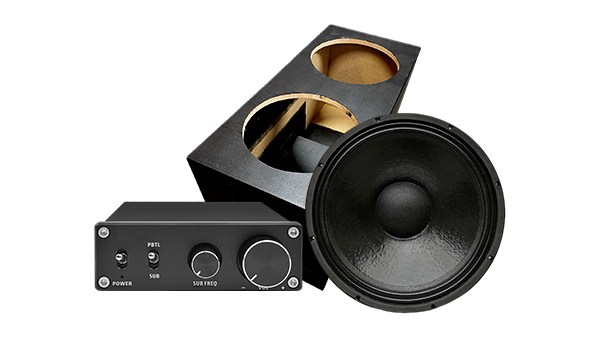
The built-in amplifier provides sufficient power to drive the subwoofer without distortion, even at high volume levels. Low-pass filters ensure that only bass frequencies are reproduced, enhancing clarity. The enclosure—sealed or ported—is carefully engineered to boost efficiency and control resonance, further improving bass response.
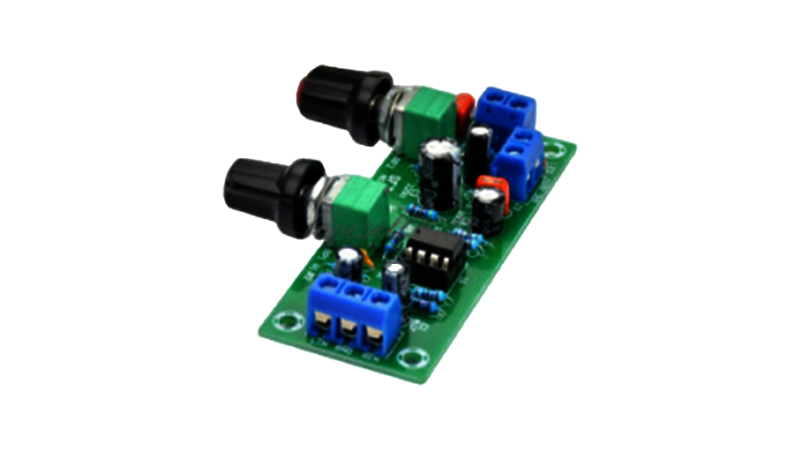 1. What Is a Subwoofer?A subwoofer is a speaker dedicated to reproducing low-pitched audio frequencies, typically ranging from 20 Hz to 200 Hz. Unlike regular speakers that handle a broad spectrum of sound, a subwoofer focuses exclusively on bass. This specialization allows it to produce deep, powerful sounds like the rumble of an explosion or the rich tones of a bass guitar, which standard speakers may struggle to handle. By offloading bass duties to the subwoofer, other speakers can focus on mid and high frequencies, resulting in clearer, more balanced sound.
We will take the party speaker as an example to explain how the distribution of bass, midrange, and treble is achieved through an crossover audio speakers frequency divider in following content. A crossover is an electronic or passive circuit device that divides the full-range audio signal into different frequency bands and directs them to the corresponding speaker drivers.
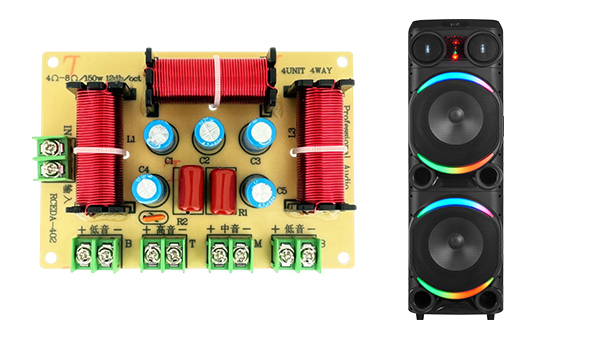 The Party Speaker shown above is a typical multi-unit design, including a bass unit, a midrange unit and a tweeter unit. The frequency divider will divide the audio signal into different frequency bands and distribute them to the corresponding speaker units.From the above crossover, we can clearly see that this crossover unit contains two bass channels, one midrange channel and one treble channel, taking into account the low, mid and high sound frequency bands.The following table is a division table of sound frequency bands that is well-known to most professionals.
| Frequency Range |
Audio Type |
Assigned Speaker Driver |
| 20Hz – 200Hz |
Bass |
Subwoofer or Woofer |
| 200Hz – 2~5kHz |
Midrange |
Midrange Driver |
| Above 2~5kHz |
Treble |
Tweeter |
The Party Speaker, through its built-in crossover, distributes the full-frequency audio signal to the bass, midrange and tweeter units according to the frequency range. Combined with a multi-speaker structure, it achieves a balanced playback effect of powerful low frequencies, rich midfrequencies and clear high frequencies, allowing you to experience a comprehensive auditory impact at the party.
2. Types of Subwoofers
● Subwoofer For Soundbar
1) soundbar with built in subwoofer
The Soundbar with a built-in subwoofer integrates the low-frequency speaker directly inside the soundbar shell, allowing for the playback of bass without the need for additional equipment. Its advantages lie in its integrated structure, easier installation and space-saving, making it suitable for small-sized apartments or desktop environments like TV stand,TV cabinet,computer desk,etc.
Soundbar with Built in Subwoofer Features:
-All-in-one design
-No wiring required, flexible placement
-Limited low-frequency effect, relatively weak shock
2) Soundbar with external subwoofer
The Soundbar system with an external subwoofer leaves the heavy bass part to an independent subwoofer. Subwoofers are larger in size and have more specialized units. They are usually connected wirelessly or wired, providing a deeper, more powerful and impactful low-frequency experience.
Soundbar with External Subwoofer Features:
-Powerful bass with more immersive sound
-Flexible placement (soundbar with wireless subwoofer)
-Takes up more space and requires a separate power supply
3) Soundbar with Built-in Subwoofer VS Soundbar With External Subwoofer Comparison
| Feature |
Built-in Subwoofer Soundbar |
External Subwoofer Soundbar |
| Design |
All-in-one, integrated design |
Separate units (soundbar + subwoofer) |
| Setup Convenience |
Easier setup, no additional wiring |
Requires placement and power connection |
| Space Usage |
Compact, space-saving |
Takes up more floor space |
| Bass Performance |
Moderate, suitable for casual use |
Deep, powerful bass for immersive sound |
| Ideal For |
Users with limited space or light use |
Movie, music, and gaming enthusiasts |
Built-in TV speakers often sound thin and lack depth.While a soundbar enhances clarity and volume, a subwoofer is essential for delivering a truly immersive,cinematic experience.It brings powerful low-end response that reproduces explosions,drumbeats, and engine roars—so you don’t just hear the sound, you feel it.
In a soundbar system,low-frequency signals (typically 20Hz – 200Hz) are filtered out by the crossover and specifically routed to the subwoofer for playback.The crossover ensures that mid and high frequencies are blocked from entering the subwoofer to avoid distortion,while also preventing low frequencies from being sent to the midrange or tweeter drivers.This allows each speaker unit to focus on its optimal frequency range,resulting in clearer,more accurate overall sound performance.
Whether the soundbar features a built-in or external subwoofer,a crossover is essential for managing frequency distribution and channel separation.A high-quality crossover design is key to delivering deep,powerful bass,rich midrange,and crisp treble!
● Subwoofer For Party Speaker
1) Subwoofer in single party speaker
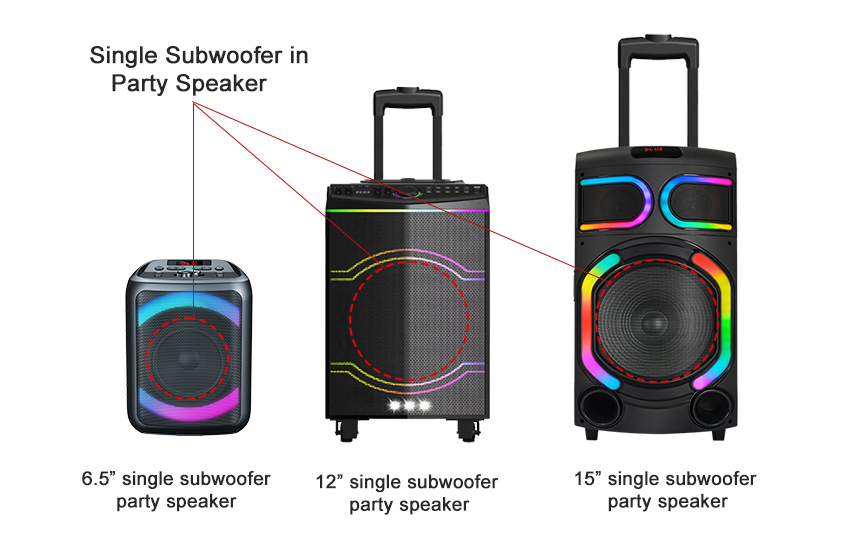
In a single party speaker, the subwoofer (bass driver) is usually located in the lower part or front lower section of the party speaker. Visually, it appears as a large circular speaker unit, making it one of the most noticeable components of the Party Speaker. It is significantly larger than the midrange and tweeter units, and is responsible for reproducing low-frequency sounds such as drum beats, deep bass, and powerful rhythms—acting as the "bass engine" that drives the party atmosphere.
2) Subwoofer in dual party speaker
In a dual Party Speaker system, each party speaker is typically equipped with two large-sized subwoofer drivers, usually arranged vertically in the center or lower section of the speaker. These are among the most visually prominent components of the entire unit.
To appeal to younger users in today's market, manufacturers often add LED light strips around the subwoofer outlines, creating dynamic lighting effects that enhance the party atmosphere.
These subwoofers are designed to reproduce deep bass, pounding drum beats, and powerful rhythms. Working in tandem, the dual subwoofers deliver stronger and more immersive low-end sound, creating a more impactful and energetic party experience.
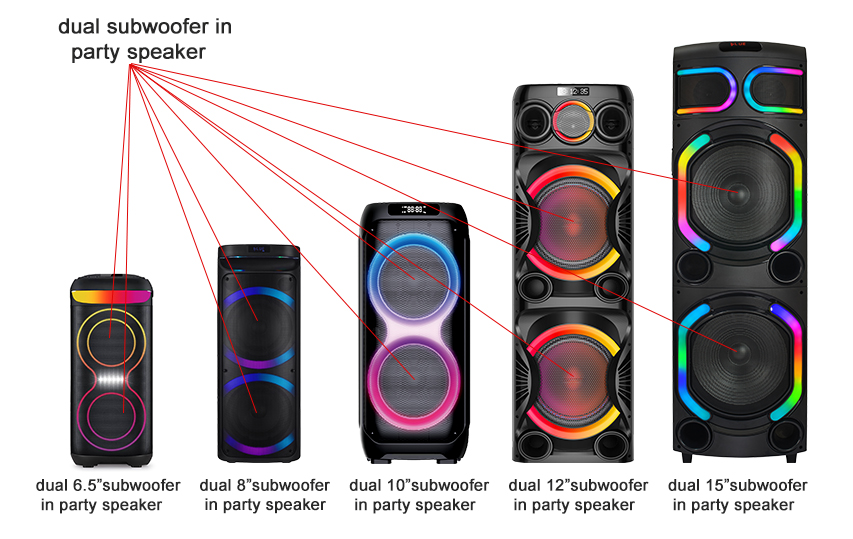
In a Party Speaker, the subwoofer receives and plays low-frequency signals with precision through a crossover. The crossover functions by dividing the full-range audio signal into different frequency bands and directing each band to the corresponding speaker driver. The low-frequency range is filtered out and sent specifically to the subwoofer, enabling it to deliver deep and powerful bass effects.
● Subwoofer For Tower Speaker in Home Theater System
A standard home theater system typically consists of front speakers, a center speaker, surround speakers, a subwoofer, and an amplifier or AV receiver. The front speakers handle the main music, dialogue, and front-facing sound effects; the center speaker focuses on vocals and the central soundstage, ensuring speech clarity; surround speakers enhance ambient effects and directional cues to create an immersive audio environment. The subwoofer is dedicated to reproducing low-frequency sounds such as drum beats, explosions, and engine roars, delivering powerful and impactful bass. The amplifier or AV receiver serves as the system's control hub, decoding, distributing, and driving all audio signals.
In a standard home theater system, the amplifier or AV receiver is responsible for decoding, amplifying, and distributing audio signals into different channels, such as front left, front right, surround, center, and subwoofer. The crossover, on the other hand, further divides the audio signal within each speaker or the system itself, allocating different frequency ranges to the appropriate speaker drivers. Even with an amplifier or AV receiver in place, the crossover remains an essential component, ensuring that each speaker driver handles the correct frequency band for clearer, more balanced sound performance.
The above content explains the classification of subwoofers in applications and clarifies the relationship between subwoofers and crossovers. Based on the need for an external power source, subwoofers can also be categorized into active subwoofers and passive subwoofers.
What is Active Subwoofer
An active subwoofer is a type of subwoofer with a built-in amplifier, meaning it doesn't require an external amp to function. It only needs a power connection and an audio signal input to operate. The following are three examples of active subwoofers in practical applications.
1) Active Subwoofer in Home Theater Systems
In a home theater setup, an active subwoofer is responsible for reproducing deep, impactful low-frequency effects such as explosions, engine roars, or earthquakes. Since it comes with a built-in amplifier, it connects directly to the AV receiver, delivering powerful and accurate bass that enhances the immersive viewing experience.
2) Wireless Active Subwoofer in Soundbar Systems
Many modern soundbars are paired with wireless active subwoofers. These subwoofers connect via Bluetooth or other wireless methods and only require a power source. This setup allows users to enjoy rich, deep bass without complicated wiring, making it a convenient upgrade for TV audio.
3) Built-in Active Subwoofer in Party Speakers
Large party speakers often include built-in active subwoofers. With a built-in amplifier, these subwoofers drive large bass drivers to deliver booming drum beats and pulsing rhythms. They create an energetic party atmosphere and are easy to use—just plug in and play, with no need for additional equipment.
What is Passive Subwoofer
A passive subwoofer is a type of bass speaker that does not have a built-in amplifier. It requires an external amplifier or AV receiver to drive it in order to function properly. While it is responsible for reproducing low-frequency sounds, it cannot amplify audio signals on its own and relies entirely on external power sources.
In simple terms, a passive subwoofer is like a "powerful warrior who needs a commander" — it has the potential for strong performance, but needs external guidance and energy. Passive subwoofers are commonly used in traditional home theater systems, professional audio setups, or scenarios where users want greater flexibility and customization. They are ideal for those with higher audio demands and room to expand their setup.
The following are three examples of passive subwoofers in practical applications.
1) Traditional Home Theater Systems
In many classic home theater setups, passive subwoofers are used alongside AV receivers. These systems often include a separate amplifier that distributes power to each speaker channel, including the subwoofer. Using a passive sub allows homeowners to pair it with a high-powered amp, achieving deeper and more controlled bass performance tailored to their room acoustics.
2) Custom Car Audio Systems
Car audio enthusiasts frequently install passive subwoofers in their vehicles for customized sound. These subwoofers are connected to dedicated car amplifiers, allowing users to select their preferred sub size and power level. This setup delivers booming bass without the limitations of built-in amplifiers, which is essential for achieving concert-like sound on the road.
3) Professional Audio Installations
In large venues like theaters, clubs, or live performance spaces, passive subwoofers are commonly used as part of a professional PA system. Sound engineers match them with powerful rack-mounted amplifiers and fine-tuned crossovers to ensure consistent low-frequency coverage. These setups offer scalability, making passive subs ideal for delivering thumping bass to large audiences.
Active Subwoofer VS Passive Subwoofer
| Item |
Active Subwoofer |
Passive Subwoofer |
| Built-in Amplifier |
Yes, has a built-in amplifier |
No, requires an external amplifier |
| Connection Method |
Connects directly to source or AV receiver's sub-out |
Needs wiring from an external amplifier |
| Installation Ease |
Simple setup, ideal for beginners and home users |
More complex, requires compatible amp and crossover |
| Tuning Controls |
Usually has volume, crossover frequency, and phase knobs |
Relies on external amp or processor for adjustments |
| Price & Flexibility |
Slightly more expensive, but plug-and-play and highly compatible |
Often more affordable, more customizable, flexible pairing |
| Common Applications |
Home theater, desktop audio, portable systems |
Professional audio setups, custom home theaters, car audio |
3. Why Is a Subwoofer Important?Adding a subwoofer to your sound system improves audio quality in several ways. Firstly, it creates a more immersive listening experience, especially for music genres with prominent bass, like hip-hop, EDM, and rock. In home theaters, a subwoofer enhances the impact of action scenes, allowing you to feel the intensity of explosions, car chases, and deep sound effects. Even in casual listening, a subwoofer adds richness to audio, making dialogues sound fuller and music feel more engaging.Furthermore, a subwoofer allows for a more even distribution of sound across a room. While smaller speakers might struggle with bass reproduction, a subwoofer fills in these gaps, resulting in smoother, more consistent sound throughout the listening space.
A subwoofer plays a vital role in enhancing the overall sound performance and creating an immersive audio experience. Here's why it's essential:
1) Enhances Low Frequencies: Regular speakers often struggle to reproduce the low-frequency range (20Hz–200Hz) accurately. A subwoofer is specially designed to handle these deep bass sounds such as drum beats, explosions, and engine roars, delivering a more powerful audio impact.
2) Boosts Atmosphere: Whether you're watching movies, playing games, or hosting a party, low-frequency effects help create a vivid, immersive atmosphere. A subwoofer lets you not only hear the sound but also feel it—adding depth and excitement.
3) Reduces Load on Main Speakers: By offloading the bass duties to the subwoofer, your main speakers can focus on mids and highs, resulting in clearer vocals and more detailed audio. This leads to a more balanced and transparent overall sound.
4) Creates a More Dimensional Soundstage: A well-integrated subwoofer adds depth and directionality to sound, especially in multi-channel systems, helping to recreate a theater-like spatial experience with rich dynamics.4. Choosing the Right Subwoofer Size
1) Choose Based on Room Size Small Room (e.g. bedroom/study under 10㎡): A 6.5"–8" subwoofer is sufficient—compact yet capable of delivering decent bass. Medium Room (e.g. living room or media room 10–25㎡): A 10"–12" subwoofer offers fuller, deeper bass—ideal for movies and music. Large Room (home theater or open space over 25㎡): A 15" or larger subwoofer provides deep, powerful low-end, perfect for immersive cinematic experiences.2) Choose Based on Usage Everyday movie watching or music: 8"–10" is a balanced choice for clarity and punch. Action movies, gaming, or party use: 12" or larger subwoofers are recommended for intense, dynamic bass. Audiophile or pro-level setup: Consider dual subwoofers or oversized models for ultra-precise low frequencies.3) Match with Your Audio SystemThe size and power of the subwoofer should be compatible with your main speakers or soundbar system. An oversized or undersized subwoofer can cause audio imbalance. For instance,Samesay equips its soundbars with subwoofers of different sizes to ensure optimal sound quality, tailored to various usage scenarios and room environments.
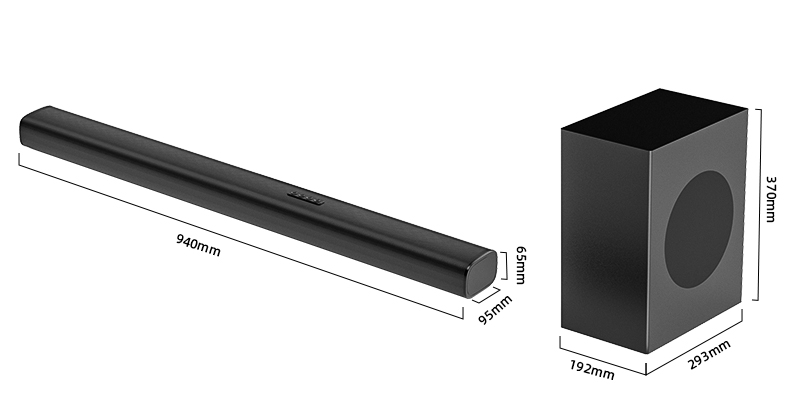
Dolby Atmos Series - SRA3080G Soundbar with Subwoofersoundbar size : 940*95*65mmsubwoofer size : 192*293*370mm
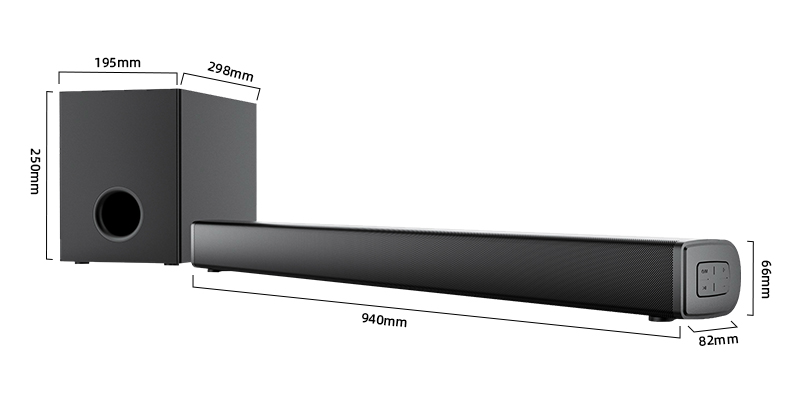
 Dolby Digital Series - SR190DG-32-120 Soundbar and Subwoofersoundbar size : 940*82*66mmsubwoofer size : 195*250*298mm
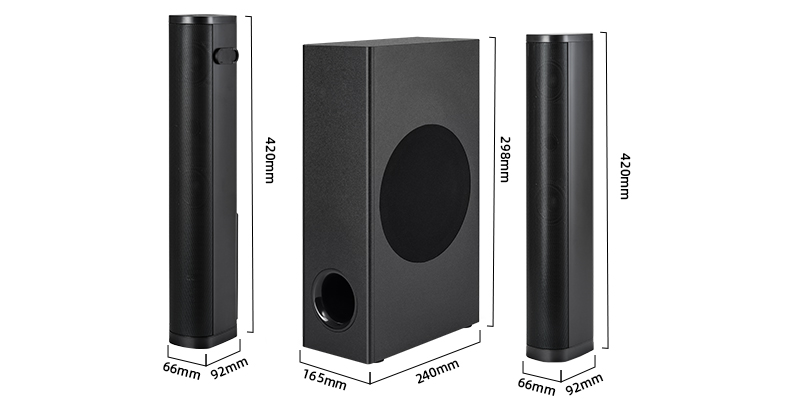
 Detachable Soundbar Series - SR253 Detachable Soundbar and Subwoofer2 * soundbar size : 420*92*66mmsubwoofer size : 165*298*240mm
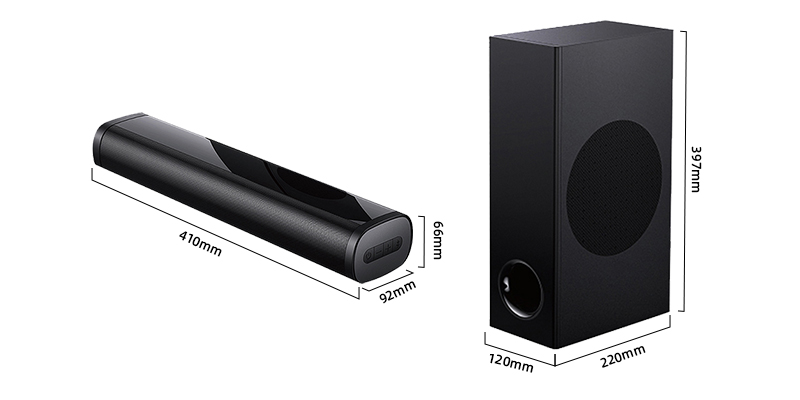
 Mini Soundbar Series - SR180G Mini Soundbar with Subwoofersoundbar size : 410*92*66mmsubwoofer size : 120*220*397mm
For home theater systems, the selection of subwoofer sizes can be referred to as follows1) Room SizeSmall rooms (<15㎡): An 8-inch or 10-inch subwoofer is recommended. It's compact, saves space, and still delivers solid low-frequency performance.Medium rooms (15㎡–25㎡): A 10-inch or 12-inch subwoofer balances depth and sound coverage well.Large rooms (>25㎡): Consider a 12-inch or even 15-inch subwoofer for more powerful, immersive bass effects.2) Usage NeedsIf you love action movies, live concerts, or gaming, go for a larger subwoofer for stronger bass.For TV shows, news, or dialogue-heavy content, a smaller subwoofer may be more than enough.3) System ConfigurationIf your system already includes large main speakers, a smaller subwoofer can provide a good low-end supplement.If your main speakers are small, a larger subwoofer is recommended to make up for low-frequency gaps.4) Placement SpaceBigger subs take up more floor space. Be sure to check your available room layout before purchasing.
Subwoofers of party speaker come in various sizes, typically ranging from 6.5 to 15 inches. Larger subwoofers (12 inches and above) produce more powerful bass and are suitable for large space or outdoor. Smaller subwoofers (6.5 to 10 inches) are compact and friendly to mobility, offering balanced bass .
Choosing the right size is better than just going bigger.Consider your room size, content preferences, and budget to find the subwoofer that delivers the best results for your setup.5. Placement and Setup TipsWhere you place a subwoofer greatly affects sound quality. Generally, subwoofers perform best when placed near a wall or corner, as this positioning amplifies bass frequencies and fills the room more evenly. Experimenting with different placements can help you find the ideal spot. Additionally, adjusting the subwoofer's crossover frequency, volume, and phase settings can help achieve the best sound balance with your other speakers.A subwoofer is an essential addition for anyone seeking a richer, more powerful audio experience. By reproducing deep bass frequencies, it adds fullness to music, realism to movies, and balance to any sound system. Understanding the different types, sizes, and placement options can help you make the most of a subwoofer in your setup, ensuring an audio experience that truly resonates.


